
Thiên Tín Journal · Guides
Materials
Which Materials Should You Choose for Your Interior Joinery? 5 Essential Criteria to Consider
When embarking on an interior project, many homeowners begin by selecting their preferred kitchen designs, wardrobe styles, or colour palettes without truly exploring the core materials beneath the surface.
Page 4
Thiên Tín Journal · Guides
Page 5
When embarking on an interior project, many homeowners begin by selecting their preferred kitchen designs, wardrobe styles, or colour palettes without truly exploring the interior materials within. It is only when quotes arrive that the distinctions between solid wood, engineered wood, polymers, stainless steel, or aluminium honeycomb make the choice challenging.
In truth, no single material suits every space. Kitchen cabinetry requires careful consideration of moisture resistance and ease of cleaning, whilst wardrobes prioritise storage functionality, and media units demand aesthetic harmony.
How, then, should one choose the right materials for interior joinery? Here are five key criteria to help homeowners evaluate and select options tailored to their lifestyle, practical requirements, and budget.
1. Commonly Used Interior Materials Today
1.1. Solid Wood and Engineered Wood – Two Familiar Material Categories
Timber remains one of the most popular materials in home furniture craft. However, solid wood and engineered wood differ substantially in structure, characteristics, and investment level.
Solid wood is crafted from genuine timber, celebrated for its unique grain patterns and natural tactile warmth. Depending on the species, it is suited to dining sets, beds, wardrobes, internal doors, and numerous bespoke pieces.
However, natural wood breathes and responds to ambient moisture. If the raw timber is not properly seasoned or if the structural design fails to accommodate movement, the furniture may warp or split over time.
Engineered wood refers to materials manufactured from wood fibres combined with binding agents or specialised processing methods. Common types include MDF, HDF, and chipboard.
The advantage of engineered wood lies in its wide array of surface finishes, its suitableness for sleek, modern designs, and a broad range of price points. Nevertheless, moisture resistance, stability, and longevity depend heavily on the core type, manufacturing standards, surface overlays, and joinery techniques.
Therefore, when selecting engineered wood, clients should look beyond simply asking whether a cabinet is made of MDF or HDF; it is essential to understand the specific core quality, surface finish, and suitable operational environment.
1.2. Aluminium Honeycomb, Stainless Steel, and Polymers – Alternative Options Worth Exploring
Beyond timber, metal and polymer-based materials are gaining traction in contemporary interior design, particularly in spaces prone to humidity.
Aluminium honeycomb is a panel material comprising a hexagonal aluminium core sandwiched between outer layers to form a rigid structure. The metallic core does not absorb water or swell like wood fibres, nor does it attract termites.
This material can be crafted into structural components for kitchens, wardrobes, vanity units, shoe cabinets, media units, or interior doors. However, load-bearing capacity and performance still depend on panel construction, edge-banding, and joint detailing.
Stainless steel is widely utilised in household appliances, fittings, and select modular cabinetry. Its corrosion resistance depends on the steel grade, operating environment, and fabrication refinement.
Meanwhile, interior polymers encompass various types, each with distinct compositions and properties. Whilst some are suitable for humid-zone cabinetry, their load-bearing capacity, dimensional stability, and surface durability must be evaluated on a product-by-product basis.
One should not assume that all metal or polymer materials offer absolute waterproofing, zero deformation, or identical lifespans.
[Internal link: How is aluminium honeycomb panel applied in interior design?]
1.3. Why Materials Should Never Be Chosen Solely on Price or Appearance
A common pitfall in interior commissioning is selecting materials based purely on initial cost or the visual appeal of a finished showcase.
Two cabinets that look identical externally may differ significantly in their internal construction. Material specifications, thickness, hardware systems, edge finishing, and assembly methods all impact overall performance and longevity.
For instance, two wood-grain kitchen runs may look virtually indistinguishable, yet one could be built from solid timber, another from engineered wood, and a third from aluminium honeycomb with a matching finish. Despite similar looks, their physical characteristics and maintenance requirements vary greatly.
Similarly, a lower-priced cabinet is not necessarily economical if its construction fails under daily conditions. Conversely, specifying premium materials for every single element is not always required.
In a dry bedroom setting, aesthetic elegance and tailored storage take priority. In contrast, under-sink units or bathroom environments demand rigorous attention to humidity and direct water exposure risks.
Thus, before comparing prices, homeowners ought to define the exact requirements for each zone. This provides a clear foundation for choosing appropriate materials, avoiding unnecessary expenditure on superfluous specifications.
2. Five Key Criteria for Selecting Interior Materials
2.1. Criterion 1: Durability and Functional Suitability
Durability is a paramount concern for clients, yet it should not be reduced to which material feels harder or boasts a longer advertised lifespan.
In fine furniture, true durability is measured by how effectively a piece fulfils its functional purpose. A bespoke wardrobe must operate effortlessly under daily use, whilst media unit shelves must safely support structural loads and heavy equipment.
For solid wood, timber quality, moisture content, and joinery techniques dictate long-term stability. For engineered wood, the core grade, surface overlay, and edge-banding precision are paramount.
For aluminium honeycomb, core specification, surface skins, and load-bearing joint designs must be carefully examined. With stainless steel or polymers, performance likewise relies on grade, thickness, and structural design.
This demonstrates that durability does not reside in raw panels alone. Hardware, hinges, drawer runners, and precision craftsmanship directly dictate the long-term luxury experience.
When selecting materials, homeowners should establish beforehand what items will be stored, the frequency of use, and any special weight-bearing requirements.
The ideal material is one that meets the exact technical demands of the piece, rather than one boasting maximum specifications across every metric.
2.2. Criterion 2: Moisture Resistance, Termite Resistance, and Environmental Factors
Moisture levels play a crucial role when choosing interior materials, particularly in kitchens, bathrooms, or cabinetry positioned against external walls.
For timber-based products, moisture absorption and movement vary by material. Solid wood naturally expands and contracts with humidity, whereas engineered wood exhibits varying water resistance depending on core composition and sealing layers.
Materials such as aluminium honeycomb or stainless steel do not swell from water absorption like timber fibres. Nevertheless, the overall water resistance of the finished piece still hinges on surface treatments, edge seals, joints, and hardware fittings.
Regarding pest resistance, wood-based materials must be evaluated based on timber treatment and preventative measures. In contrast, aluminium cores and stainless steel offer no food source for termites.
Even so, incorporating metallic materials does not single-handedly eliminate pest risks across a building; other timber elements within the property may still remain vulnerable if an infestation exists.
In persistently humid areas, both cabinet construction and site installation conditions require attention. Damp walls or leaking pipework must be remedied prior to fitting custom joinery.
[Internal link: Is aluminium honeycomb furniture waterproof and termite-resistant?]
2.3. Criterion 3: Aesthetics and Spatial Cohesion
Interior materials shape not only structural integrity but also define the atmospheric character of a living space.
Solid timber excels in natural grain beauty and organic tactile warmth. It is the perfect choice for homeowners who cherish genuine wood or wish to curate organic statement features.
Engineered wood, meanwhile, offers a vast spectrum of surface finishes such as melamine, laminate, or bespoke lacquers, rendering it exceptionally versatile for modern architectural styles.
Aluminium honeycomb can also be tailored with diverse surface finishes depending on specification, ranging from refined neutral tones to realistic timber veneers. Stainless steel, by comparison, complements minimalist metallic aesthetics or architectural glass pairings.
However, visual elegance relies on far more than just a single panel choice. Cabinet proportions, door divisions, refined edging, architectural hardware, and lighting integration all contribute to the final composition.
For instance, an apartment featuring light oak flooring and cream walls benefits from complementary cabinetry tones to establish seamless continuity. Conversely, mixing disparate wood grains can disrupt spatial harmony.
Homeowners are thus advised to select materials within the context of the overarching interior scheme and to evaluate physical samples under realistic lighting conditions.
2.4. Criterion 4: Capital Investment and Long-Term Maintenance
Cost is undoubtedly an essential consideration, yet it should be evaluated across the complete finished installation rather than by raw material unit price alone.
A complete piece of cabinetry encompasses carcases, doors, shelving, hardware, surface finishes, craftsmanship, and installation. Consequently, pricing variations between material specifications reflect numerous interdependent factors.
With solid wood, pricing stems from timber species, timber grade, and artisan fabrication complexity. Engineered wood offers a broad investment spectrum based on core type, decorative overlay, and construction.
Aluminium honeycomb, stainless steel, or synthetic materials also offer various product configurations at different price points. One should not automatically assume that one material group is always cheaper than another.
Beyond the initial cost, homeowners should consider cleaning requirements, maintenance, and the ease of replacing fittings.
For instance, certain timber surfaces may require ongoing care or refinishing over time. For metal cabinetry systems, maintenance typically focuses on the surface finish, hardware, and joint connections.
When comparing quotations, options with identical dimensions, functionality, and hardware tiers should be evaluated side by side. This helps clarify whether price differences stem from the materials themselves or the underlying construction.
The most economical choice is not always the one with the lowest initial price, but rather the solution that best aligns with your budget and long-term living requirements.
2.5. Criterion 5: Workability, Ease of Cleaning, and Maintenance
A material with excellent properties may still result in an impractical product if it is unsuited to the chosen fabrication method or intended function.
For instance, kitchen cabinetry requires dedicated appliance housings, alongside tailored positioning for hinges and drawer runners. Wardrobes demand compartmentalisation suited to daily habits, whilst vanity units must accommodate plumbing systems.
Each material category presents distinct crafting requirements. Natural timber must be processed in accordance with grain characteristics and moisture content. Engineered wood demands careful attention to the core material, surface finishes, and edge-banding techniques.
With aluminium honeycomb, fixings and hardware anchor points must respect the structural composition of the panel. Stainless steel may require bespoke cutting, folding, welding, and surface-refining processes.
Ease of cleaning should also be factored in. Surfaces featuring intricate grooves, ornate detailing, or hard-to-reach recesses naturally require more effort to maintain.
For cabinetry systems with integrated appliances, practical access to electrical wiring, plumbing, or hardware must be ensured for routine maintenance.
Consequently, homeowners should not rely solely on loose material swatches. Inspecting the finished piece, testing the door mechanisms, and reviewing internal joinery details will provide a far more accurate assessment of true craftsmanship.
3. Which Interior Materials Best Suit Each Living Space?
3.1. Kitchen Cabinetry and Vanity Units – Prioritising Moisture Resistance
Kitchens and bathrooms present unique environmental conditions, characterised by frequent moisture, water splashes, and regular cleaning demands.
For kitchen cabinetry, specific attention should be given to the undersink cabinet, dishwasher housing, cooking zone, and high-frequency storage areas.
Engineered wood is suitable provided the correct core material, decorative surface, and edge-sealing techniques are selected. Solid timber also remains an excellent choice if properly treated and installed in appropriate conditions.
Materials such as aluminium honeycomb or stainless steel are well worth considering if you prefer metal-based components in areas prone to dampness.
For vanity units, resistance to steam and splashing takes priority. However, regardless of the chosen material, detailing around basin junctions, pipework, and wall interfaces must be thoughtfully engineered.
Furthermore, the cabinetry design should allow effortless cleaning and easy access to inspect for potential leaks.
Therefore, selecting materials for the kitchen and bathroom should begin with practical living requirements before moving on to preferred finishes and aesthetics.
3.2. Wardrobes, Shoe Cabinets, and Media Units – Balancing Functionality with Aesthetics
Unlike kitchen areas, bedrooms and living rooms experience far less direct contact with water. Material selection can therefore focus more on tailored storage solutions and refined visual appeal.
Wardrobes require internal configurations designed around your wardrobe volume, accessories, and routines. Floor-to-ceiling installations or large-format doors demand precise calculations regarding dimensions, structural stability, and opening hardware.
Solid wood appeals to those who cherish the tactile warmth of natural timber. Engineered wood offers a broad range of surface finishes, whilst aluminium honeycomb provides a sophisticated metal-core alternative paired with modern luxury finishes.
For shoe cabinets, considerations differ slightly as footwear introduces dirt and ambient moisture. Here, ease of cleaning and ventilation are just as crucial as the material itself.
Media units require careful attention to spatial proportions, equipment load capacity, and cable management. An aesthetically striking unit that proves difficult to service or ill-fitted for screen dimensions will compromise daily enjoyment.
It is therefore not essential to specify the same material throughout the entire residence. You may select different materials tailored to individual joinery elements, provided the overarching colour palette and design aesthetic remain harmonious.
3.3. Internal Doors and Fitted Cabinetry – Prioritising Structure and Hardware
Internal doors are subject to constant daily use; consequently, their internal structure and hardware specification play a paramount role.
Solid wood is ideal for designs requiring genuine timber texture or intricate profiling. However, structural stability hinges on the wood species, seasoning methods, and environmental conditions.
Alternative material solutions such as aluminium honeycomb must be engineered with appropriate internal reinforcements, particularly around hinges, locks, and subframe assemblies.
One should not assume that a material performing well for cabinet doors can be applied directly to passage doors without structural adaptations.
When designing integrated doors and cabinetry, establishing a dominant style and colour scheme early on is recommended. Individual joinery pieces can utilise different core materials yet achieve cohesive elegance through matching tones, balanced proportions, and complementary surface finishes.
For example, wardrobes, shoe storage, and internal doors can feature harmonious wood-grain tones to create a sense of seamless continuity. Meanwhile, areas demanding moisture resilience can adopt materials better suited to their specific environment.
This holistic approach prevents piecemeal material selection, avoiding a fragmented look when the full interior fit-out is completed.
4. Choosing the Right Interior Materials with Thiên Tín
4.1. Why You Should Inspect Material Swatches and Finished Pieces Before Deciding
Once key criteria are established, homeowners are encouraged to spend time reviewing tangible material samples prior to commissioning bespoke furniture.
3D renderings offer a helpful visual style guide, but they cannot fully convey structural integrity, tactile surface quality, or the refined level of craftsmanship.
When examining solid wood, inspect grain character, colour consistency, and joinery seams. For engineered wood, review the core composition, veneer quality, and edge-banding precision.
For aluminium honeycomb, we invite clients to examine panel cross-sections, skin layers, and fixing methods. For stainless steel or synthetic materials, the specific grade and fabrication techniques should be clearly understood.
Beyond material samples, evaluating completed pieces reveals subtle craftsmanship details rarely discernible on architectural drawings—such as reveal gaps, hinge action, drawer glide smoothness, and surface uniformity.
During consultations with suppliers, homeowners should clarify the exact scope of the quotation, product specifications, hardware selections, and warranty policies.
This transparent information provides a solid foundation for decision-making, ensuring choices are not based solely on price points or promotional imagery.
4.2. From Material Advisory to Design and Manufacturing at Thiên Tín
A truly tailored interior suite must be developed around genuine lifestyle needs, rather than material selection alone.
At Thiên Tín, our advisory process begins with spatial survey, functional assessment, and target investment level. From there, our team recommends tailored materials and design solutions for every joinery element.
Thiên Tín delivers bespoke interior solutions using diverse material categories including aluminium honeycomb, timber, synthetics, and stainless steel to cater to varying client requirements.
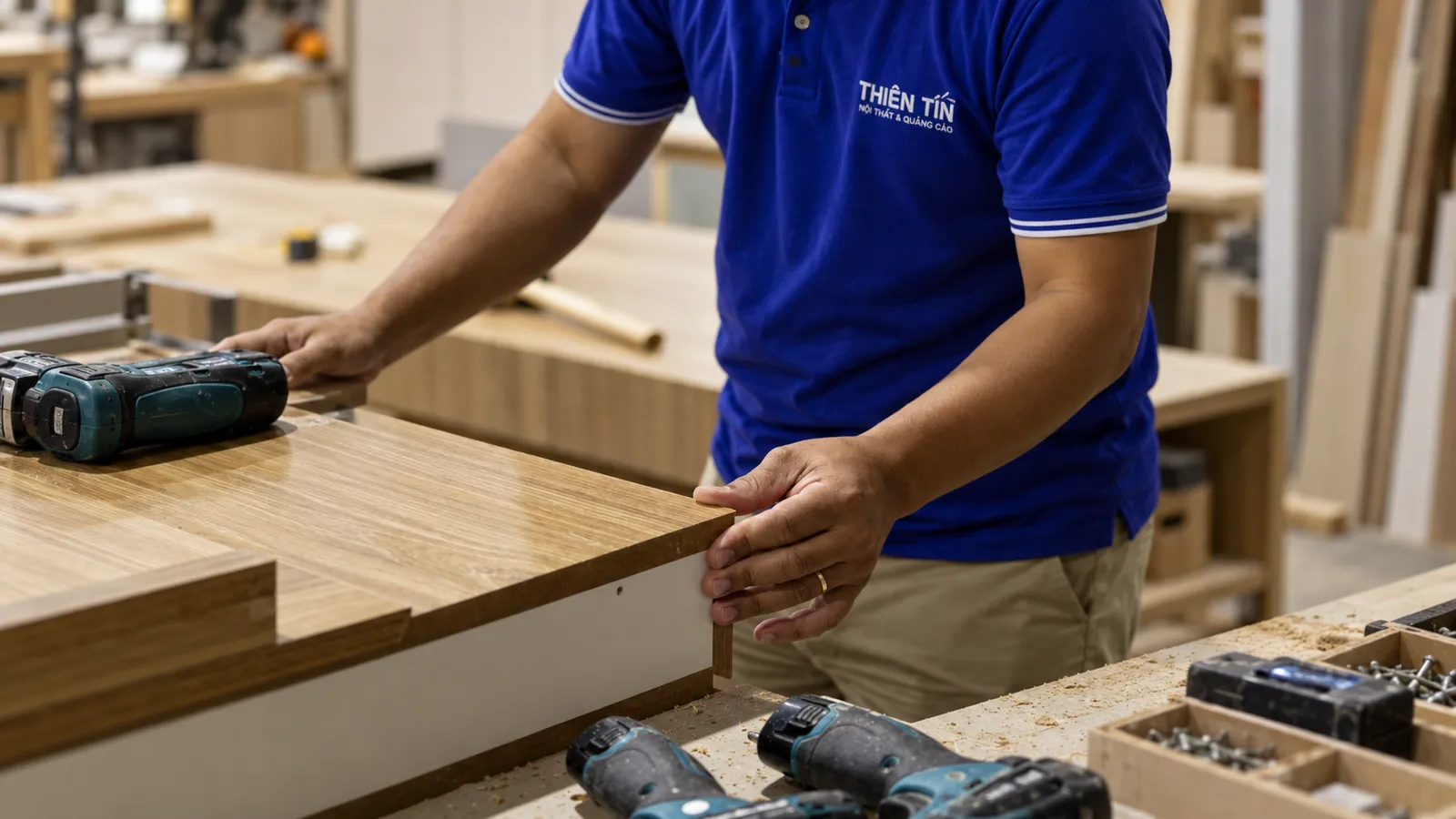
Our manufacturing process spans detailed technical drawings and component breakdowns through to precision fabrication, assembly, and hand-finishing.
In our workshop, advanced machinery—such as twin-table CNC routers, PUR edge-banders, and sensor-guided boring machines—supports precision engineering suited to each material and structural design.
However, state-of-the-art machinery never replaces technical design expertise and rigorous quality control. Meticulous edge detailing, hardware alignment, and bespoke jointing methods are carefully crafted for every individual product.
This holistic journey—from raw material to finished piece—enables clients to appreciate not only aesthetic refinement but also real-world longevity and functionality.
[Internal link: How does Thiên Tín manufacture interiors? From raw materials to finished products]
4.3. Thiên Tín – Interior Solutions Tailored to Every Lifestyle Need
No single interior material suits every project. Each material category possesses distinct characteristics and should be selected according to specific living conditions.
Solid wood is ideal for clients who cherish authentic timber grain. Engineered wood provides versatile surface options across various investment levels. Stainless steel, synthetics, and aluminium honeycomb offer sophisticated alternatives for joinery with specialized structural and environmental demands.
The crucial step is defining your exact requirements before choosing materials. A kitchen suite, wardrobe, or media unit should be evaluated on functionality, aesthetics, and overall investment value rather than material terminology alone.
At Thiên Tín, clients can explore a broad range of interior solutions, including advanced cabinetry and door systems utilizing aluminium honeycomb panels.
THIÊN TÍN – A pioneering provider of integrated cabinetry and door solutions made from next-generation aluminium honeycomb panels in Vietnam.
Driven by an approach that encompasses material advice, design, manufacturing, and finishing tailored to practical needs, Thiên Tín delivers bespoke solutions for every living space.
If you are preparing to build, renovate, or furnish your home, you are welcome to visit Thiên Tín to view material samples in person, explore our finished products, and discuss your specific requirements.
Taking into account your space, style, and expected budget, Thiên Tín will advise on the most suitable options before proceeding with design and quotation.
Thiên Tín Journal · Guides · Page 6