
Thiên Tín Journal · Guides
Products
Aluminium honeycomb TV units: modern designs for contemporary living rooms
TV units are no longer merely a place to position a television or set-top box.
Page 6
Thiên Tín Journal · Guides
Page 7
TV units are no longer merely a place to position a television or set-top box. In many contemporary apartments and townhouses, they form an integral part of the living room furniture scheme, directly influencing layout, storage capacity, and spatial perception.
Aluminium honeycomb TV units offer a compelling choice for homeowners seeking a metal-core material whilst retaining a warm, modern aesthetic through various surface finishes.
However, a design that looks stunning in photographs may not necessarily suit your actual room. Wall dimensions, screen placement, storage needs, and cable management must all be calculated prior to design.
The following article introduces popular TV unit styles, material advantages, and practical guidance on selecting the perfect fit for your living space.
What is an aluminium honeycomb TV unit, and why is it used in living rooms?
Structure and characteristics of aluminium honeycomb TV units
An aluminium honeycomb TV unit is a shelving or cabinetry system crafted from aluminium honeycomb panels, used for suitable components such as cabinet carcasses, doors, partitions, or shelves according to design.
This material features a sandwich structure, with an aluminium core formed into hexagonal cells sandwiched between surface layers. This honeycomb structure distinguishes it from natural timber, engineered wood, or conventional solid metal sheets.
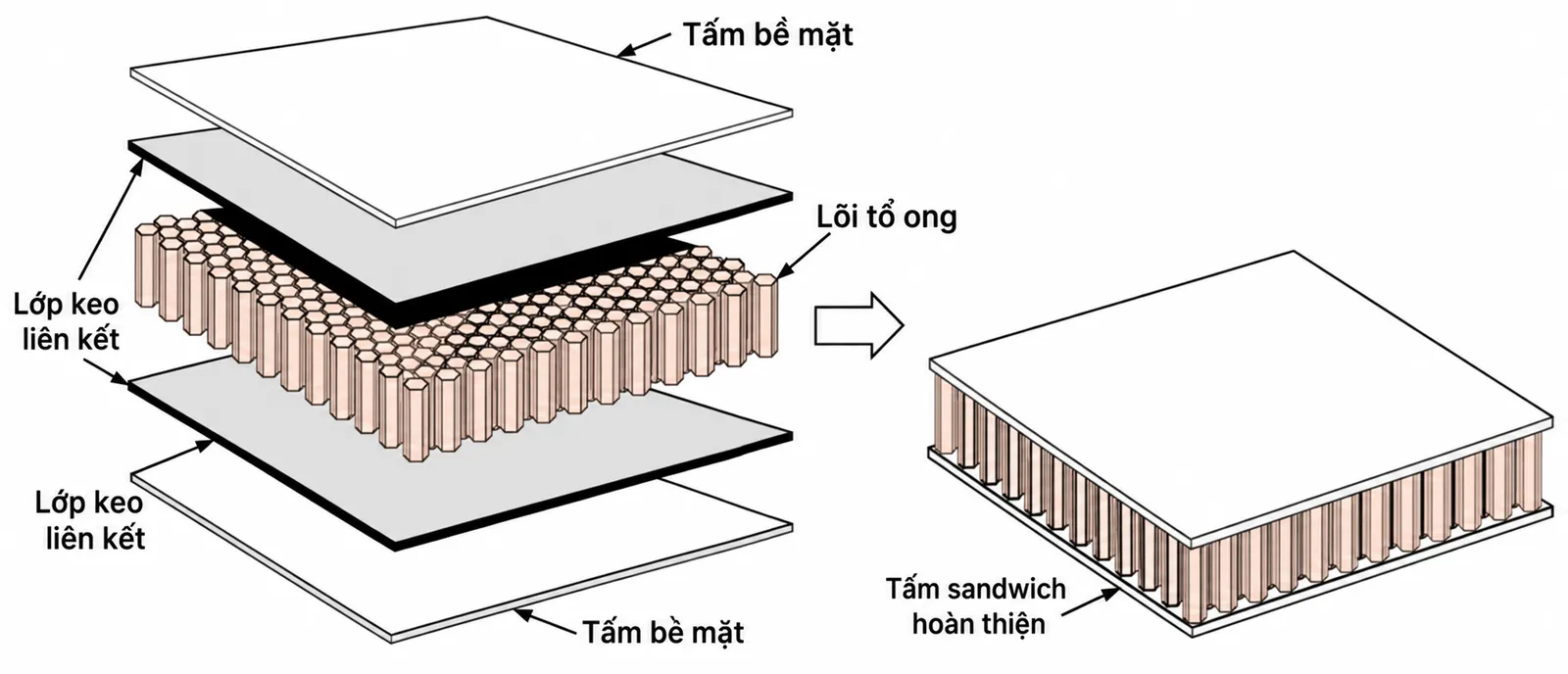
Thanks to its metal core, the material does not absorb water and swell like natural wood fibre. Aluminium also contains no cellulose, making it entirely immune to termites. These inherent properties provide long-term benefits for residential furniture.
However, the durability of a TV unit depends on more than just its core material. Shelf load capacity, cabinet stability, and smooth door operation also rely on structural design, dimensions, jointing systems, and hardware. In particular, areas designated for heavy equipment or long shelf spans must be calculated for intended loads.
Therefore, when selecting an aluminium honeycomb TV unit, homeowners should examine both material samples and finished structural construction, rather than judging solely by external appearance.
What is aluminium honeycomb? Structure, characteristics, and interior applications
Surface finishes enable TV units to suit diverse interior styles
A key feature of using aluminium honeycomb in the living room is that the metal core does not dictate the product's final appearance.
Depending on the material range, surface layers can be finished in solid colours, wood grain effects, or subtle neutral tones. Consequently, the TV unit can complement various design styles without feeling visually cold or metallic.
For minimalist apartments, shades of beige, ivory, or light grey lend the unit a lighter visual weight. Meanwhile, light wood grain or walnut surfaces create a warm feel that pairs effortlessly with timber flooring, sofas, and other interior details.
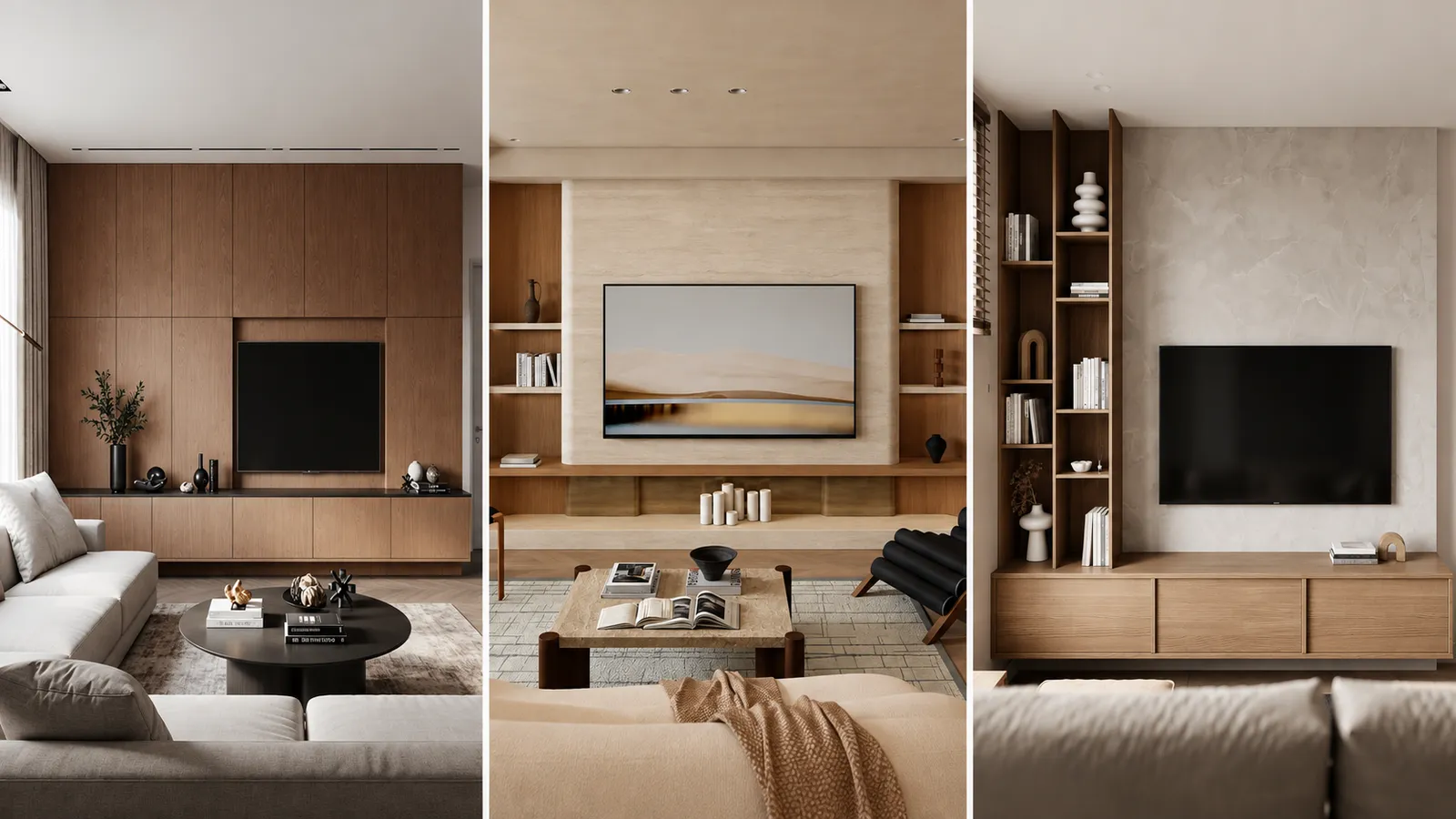
In modern living spaces, TV units can also integrate glass, decorative lighting, or wall panelling to create a striking focal point. However, combining multiple materials requires restraint to prevent the TV zone from feeling cluttered.
Harmonious colour schemes and balanced proportions are essential. A unit with exquisite surfaces can still disrupt spatial balance if it features too many compartments or excessive colour contrast.
Therefore, when choosing a TV unit, surface samples should be evaluated under lighting conditions similar to your actual living room and considered within the overall interior context rather than in isolation.
What functional requirements must a TV unit meet beyond aesthetics?
In contemporary living rooms, televisions are frequently wall-mounted. As a result, the primary role of the TV unit has evolved.
Rather than merely supporting the weight of a screen, the unit can house set-top boxes, speakers, Wi-Fi routers, media equipment, or everyday items kept nearby.
Some households also utilise the cabinetry for books, decorative items, or smaller accessories. However, incorporating too many open compartments can cause the area to become cluttered, undermining the room's neat aesthetic.
Therefore, homeowners should define their AV equipment requirements prior to design. Set-top boxes and Wi-Fi routers require suitable placement for signal connectivity, while heat-emitting devices need adequate ventilation in line with manufacturer guidelines.
Power, network, and AV cabling should also be planned from the outset. A beautiful media unit with exposed wiring or awkward socket access will prove impractical in daily use.
Furthermore, for families with young children, rounded edges, safe equipment positioning, and cabinet stability require careful consideration.
A well-conceived design resolves daily functional needs while keeping the television area uncluttered, easy to clean, and straightforward to maintain.
Aluminium honeycomb TV unit designs suited to modern living rooms
Wall-mounted TV units – streamlined solutions for compact apartments
Wall-mounted TV units are a popular choice for apartments with limited living room space or for homeowners who favour a minimalist aesthetic.
Rather than resting directly on the floor, the unit is mounted at an appropriate height, creating an airy feel while leaving the floor space below easy to clean.
Visually, these designs feature clean lines, flush doors, and a balanced number of compartments. Combined with a wall-mounted TV, the result is a sleek feature that minimises visual footprint.
Aluminium honeycomb can be specified to fabricate cabinet components according to design. However, wall-mounting integrity depends not only on the cabinet material, but also on the bracket system, fixings, and wall conditions.
In particular, brickwork, concrete, and stud partition walls possess different load-bearing capacities. The installation method must be tailored to the actual structure rather than applying a universal fixture approach.
For compact living rooms, lighter tones and refined details are recommended. A unit proportioned harmoniously with the screen and wall surface delivers far better aesthetic results than attempting to stretch cabinetry across the entire wall width.
Floor-standing TV units – versatile storage solutions
Unlike wall-mounted designs, floor-standing TV units rest directly on the floor or base frame, forming a freestanding piece of furniture.
This design style suits households requiring generous storage or those who prefer a grounded look over a floating effect.
Depending on the living room area, units can be designed low-slung, extended along the wall, or crafted with a combination of enclosed cabinets and open shelves. Doors keep belongings concealed, whilst open niches offer convenient access for everyday devices.
When using aluminium honeycomb, components must be engineered to suit intended dimensions and loads. For wider units, internal vertical dividers and span spacing are critical to ensuring structural stability.
An advantage of floor-standing units is their flexible storage organisation tailored to household needs. However, depth should be carefully considered to avoid encroaching on walkways or living room circulation.
If placing the television directly on the unit top, verify the design load capacity and stand dimensions. If the TV is wall-mounted, the top surface can be used flexibly for decorative accents and media equipment.
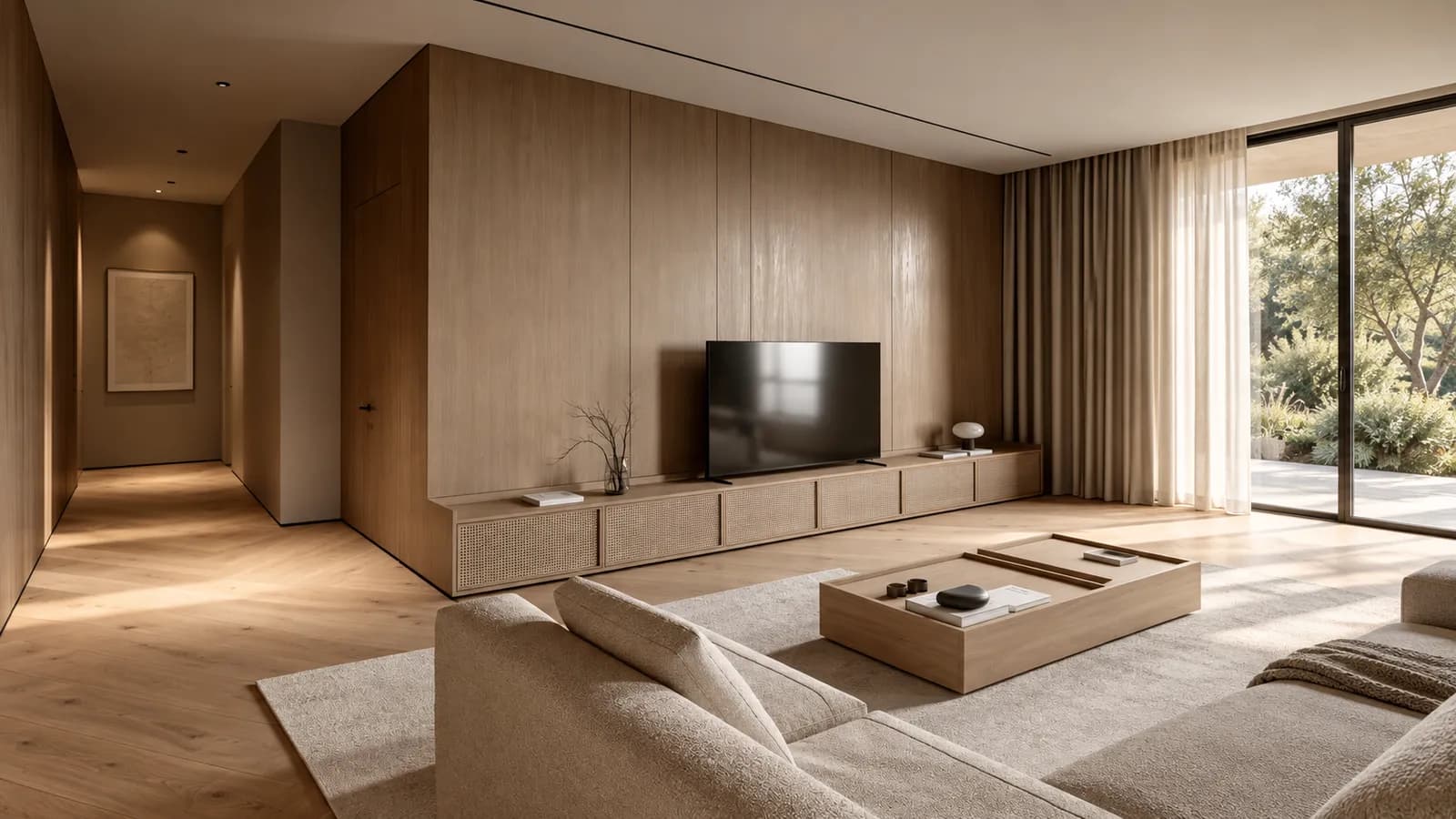
In modern living rooms, low-slung units featuring wood grain or neutral finishes integrate seamlessly with sofas and coffee tables.
TV units with integrated display cabinets – creating a cohesive interior scheme
In larger living rooms, the TV unit can be developed into a multi-functional wall system.
Rather than a single low unit, homeowners can incorporate tall cupboards, display niches, or open shelving flanking the screen. This approach optimizes wall space while achieving visual consistency.
However, large wall systems are not suitable for every living room. Incorporating too many compartments or dark finishes across expansive surfaces can make the room feel visually heavy.
Therefore, a proportioned balance between the screen, storage zones, and negative space is essential. A sophisticated unit balances closed storage, open display, and revealed wall surfaces.
With aluminium honeycomb, homeowners can select unified finishes across cabinet carcasses, doors, and related components. Elements such as glass, decorative lighting, or wall cladding can be combined to support the design vision.
Crucially, the wall unit must be planned alongside electrical and media layouts. Access routes for speakers, receivers, and power sockets should be designed for convenient maintenance.
Integrated TV and display units suit families looking to utilise a living room wall for both practical storage and an architectural focal point.
TV units with integrated wall panelling – creating a living room feature wall
In open-plan living-dining areas or rooms with expansive walls, TV units can be combined with wall panelling to create a clearer layout structure.
The wall panel behind the television serves as a visual backdrop, while the lower unit fulfills storage needs. Designed together, the TV area becomes the living room's defining focal point.
Depending on the style, feature walls can incorporate neutral tones, wood-grain effects, or a combination of other materials. However, overusing multiple grains and colours on a single wall section should be avoided.
A straightforward approach is using a wood-grain finish as a focal point, paired with a TV unit in beige or soft grey. For light-filled living rooms, deeper surfaces may also be considered if they complement the overall scheme.
When designing a media wall, the screen position, electrical wiring, and mounting system must be determined in advance. A decorative wall panel does not automatically possess the load-bearing capacity for a television; the mounting system must be anchored to an appropriate structure according to technical specifications.
Furthermore, future screen size upgrades should be taken into account. A design overly tailored to a single TV dimension may prove inconvenient when upgrading your entertainment system.
Therefore, a TV unit combined with wall panelling should be designed with balanced proportions, practical functionality, and long-term adaptability in mind.
How to select an aluminium honeycomb TV unit suited to your space and requirements
Choosing proportions based on wall space, screen size, and viewing distances
Dimensions are amongst the most critical factors when selecting a media unit.
An oversized unit can make a living room feel cramped, whilst one that is too small relative to the wall and screen creates an unbalanced aesthetic.
Prior to designing, homeowners should establish the wall width, sofa positioning, TV dimensions, and adequate clearance for walkway circulation.
For smaller living areas, the TV unit should feature a modest depth sufficient for media equipment and storage. Increasing depth merely to create a sense of grandeur should be avoided if it encroaches upon pathways.
The height of the unit must also be considered alongside the screen position. For wall-mounted televisions, the distance between the screen and the unit's top surface should achieve visual balance whilst allowing ample space for necessary electronics.
If placing the television directly on the unit, the height must align with comfortable seated viewing angles and the base stand dimensions. These considerations may vary depending on the sofa style, seating positions, and screen type.
For media units integrated with tall cabinets, additional clearance must be allowed for opening doors and drawers.
A well-considered design should harmonise aesthetic proportions with effortless everyday use, rather than relying solely on reference model dimensions.
Selecting finishes and colours that harmonise with your living room interior
The surface finish of a TV unit directly influences spatial perception, particularly as it forms one of the most prominent focal points in the living area.
For minimalist interiors, homeowners might consider plain surfaces in beige, ivory, or pale grey. These subtle hues pair seamlessly with light walls, neutral sofas, and timber flooring.
Where a warmer ambiance is desired, wood-grain effect surfaces offer an ideal solution. Light timber tones evoke an airy feel, whereas walnut or richer shades lend depth and character to the cabinetry.
Nevertheless, colour choices should always be curated in relation to existing elements. If the living room already incorporates varied wood grains, adding another distinct grain may compromise visual coherence.
In such instances, a solid-colour media unit often proves the more refined alternative.
It is also advisable to inspect finish samples under real lighting conditions. A single shade can appear markedly different between a showroom setting and a living room bathed in warm artificial light or natural daylight.
With aluminium honeycomb, one should examine both surface samples and finished items to appreciate edge detailing, door tolerances, and modular uniformity.
Considering load capacities, hardware fittings, and ease of maintenance
A media console typically houses multiple devices of varying shapes and weights. Consequently, alongside aesthetic styling, structural load capacity must be engineered from the initial concept.
For floating units, the anchoring system must suit wall conditions and anticipated loads. For floor-standing units, structural stability, partition spacing, and top-panel load capacities require careful calculation.
Aluminium honeycomb features a distinct core structure; therefore, point-load areas and hardware attachment points must be engineered accordingly. It should not be assumed that every component can utilize uniform screwing or joining methods.
Beyond structural integrity, opening mechanisms significantly impact daily touchpoints. Hinges, drawer runners, and door mechanisms must complement the product's dimensions and architecture.
For electronic equipment compartments, convenient cable management and adequate ventilation must be provided as required by each device. Fully enclosed spaces may prove unsuitable for components that generate heat during operation.
Homeowners should also consider cleaning and maintenance. A design permitting effortless disassembly or easy access to wiring will prove far more practical when upgrading hardware.
An exquisite media unit must be crafted for practical elegance, not merely rendered for visual concept displays.
Bespoke aluminium honeycomb TV unit design at Thiên Tín
Information to prepare prior to commissioning a bespoke TV unit
To achieve a tailored design, clients should begin with fundamental details regarding their space and functional requirements.
Firstly, establish wall dimensions, sofa positioning, screen placement, and associated media hardware. If building or renovating, designating socket and cabling locations early ensures a seamlessly integrated final installation.
Next, define your storage needs. A household seeking a low console for a set-top box requires a distinctly different proposal from one desiring integrated display cabinetry, shelving modules, and extensive storage.
Interior styling should likewise be predetermined. Flooring tones, wall colours, soft furnishings, and adjacent fitted joinery serve as the baseline for selecting compatible media unit finishes.
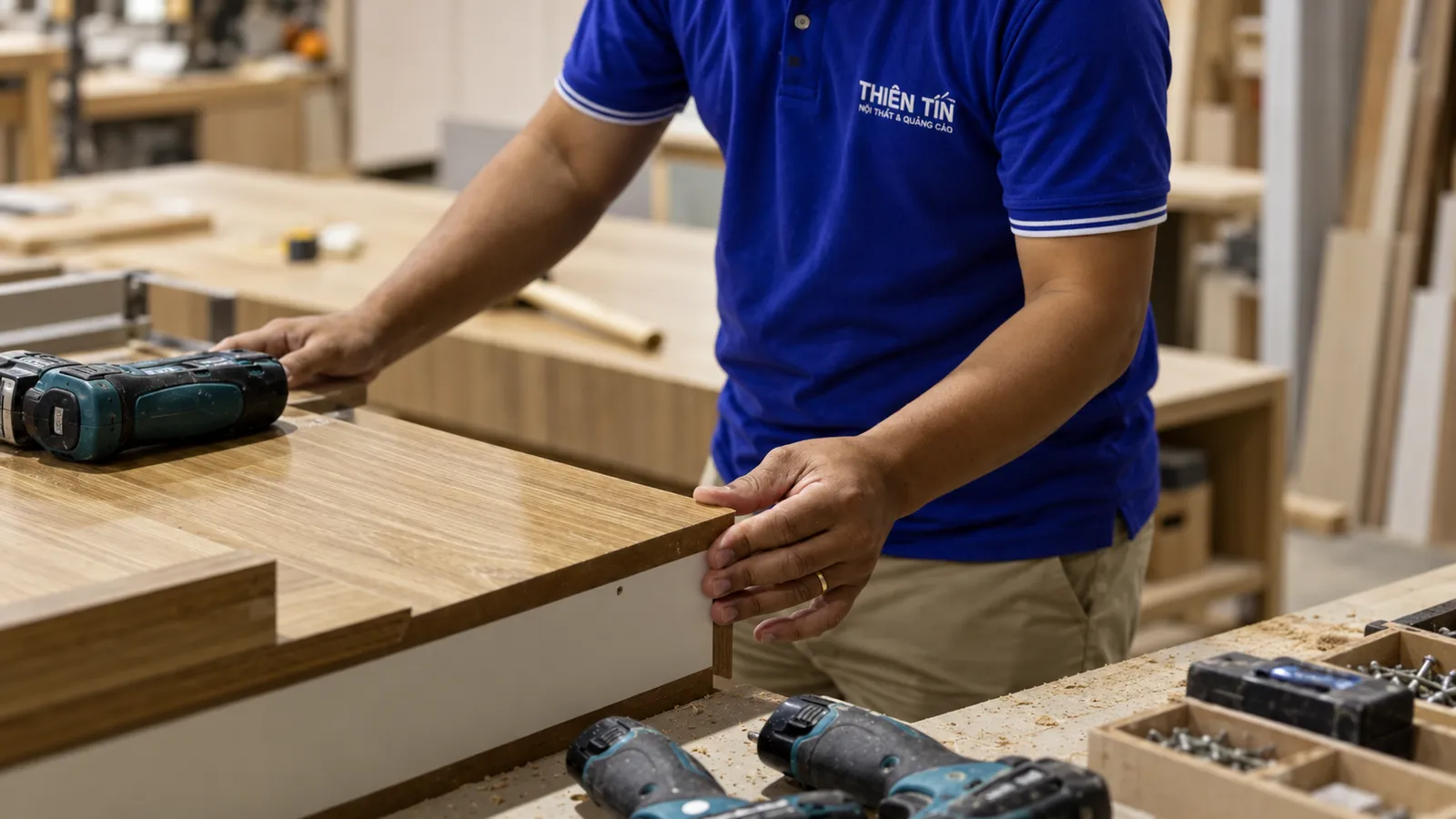
When reviewing materials, clients are encouraged to inspect physical aluminium honeycomb samples, edge banding treatments, and overall finishing quality.
Furthermore, structural details, load requirements, hardware specifications, and installation methods should be thoroughly discussed. For wall-mounted cabinetry, structural wall conditions are particularly vital.
Upon receiving a quotation, check whether the scope of supply encompasses the cabinet carcass, doors, hardware fittings, feature panelling, integrated lighting, and installation services.
Clear details at this stage ensure the design and manufacturing process aligns precisely with practical needs, minimising costly variations.
What factors influence the cost of an aluminium honeycomb TV unit?
The price of an aluminium honeycomb media unit is not fixed across all bespoke designs.
Investment levels depend primarily on product proportions and engineering complexity. A low console with basic compartments requires a very different manufacturing scope than an expansive media suite integrating tall cabinetry and decorative wall panels.
Surface finishes also impact overall investment. Depending on material specifications, plain colours, wood-grain effects, or bespoke decorative options carry varied cost structures. Hardware systems similarly play a key role; units featuring standard hinged doors, pull-out drawers, or specialized opening mechanisms require distinct crafting techniques and pricing tiers.
Should the concept incorporate wall panelling, glass elements, accent lighting, or supplementary cabinetry, these line items must be itemized clearly within the quotation. On-site installation conditions may also affect total investment, particularly where walls are out of plumb, feature service risers, or require custom fitting to existing structures.
Therefore, when comparing proposals between providers, clients should evaluate options featuring identical dimensions, construction, materials, and installation scope side by side.
A transparent quotation allows clients to appreciate the expected level of craftsmanship rather than deciding solely on the lowest initial price.
Thiên Tín – Integrated media units and matching cabinetry solutions from aluminium honeycomb panels
A TV unit is a central feature of living room design, yet it need not be crafted in isolation from surrounding interior elements.
By selecting materials and finishes through a cohesive design direction, homeowners can establish seamless visual continuity between media units, display cabinets, shoe storage, kitchen joinery, or other fitted furniture throughout the home.
At Thiên Tín, our consultancy begins with a thorough site survey, identifying functional requirements and guiding material selection. From there, our specialists propose floating consoles, floor-standing units, or integrated display joinery tailored to your floor area and aesthetic vision.
Utilizing aluminium honeycomb panels, Thiên Tín delivers bespoke interior solutions combining engineered metallic cores with refined surface finishes and precision crafting tailored to every bespoke project.
Manufacturing progresses meticulously from technical drawings, component fabrication, and edge detailing through to assembly and final finishing. Critical details such as door reveals, hardware positioning, and load-bearing joints receive careful attention to ensure longevity in everyday use.
THIÊN TÍN – Pioneers in providing comprehensive, matched cabinetry and door solutions using next-generation aluminium honeycomb panels in Vietnam.
If you are seeking an aluminium honeycomb TV unit suited to your living area, we invite you to visit Thiên Tín to experience material samples firsthand, explore design concepts, and discuss your bespoke requirements.
Guided by your spatial dimensions, interior style, and budget expectations, Thiên Tín provides tailored advice prior to advancing to detailed design and quotation.
Thiên Tín Journal · Guides · Page 8