
Thiên Tín Journal · Guides
Aluminium honeycomb
What is aluminium honeycomb? Composition, characteristics, and applications
When selecting interior materials, today's users are not only concerned with colour or price but also prioritise stability, adaptability to humid environments, and longevity during use.
Page 30
Thiên Tín Journal · Guides
Page 31
When selecting interior materials, today's users are not only concerned with colour or price but also prioritise stability, adaptability to humid environments, and longevity during use. Aluminium honeycomb is therefore gaining attention as a new material solution for cabinetry, doors, and various interior elements. The unique feature of this material lies in its core, which is formed from interconnected honeycomb-shaped cells, optimising material usage while creating a structure with excellent strength-to-weight ratio. However, to evaluate whether a honeycomb panel is truly suitable for a project, one must look at the entire composition, surface layer, bonding method, and construction technique rather than relying solely on the material's name.
What is aluminium honeycomb? The composition of aluminium honeycomb panels
What is aluminium honeycomb and why is the honeycomb structure used?
Aluminium honeycomb is the common term for a group of materials that use a metal core made of many hollow cells connected in a shape similar to a honeycomb. In material engineering, honeycomb is often used as the core for sandwich structures, where a lightweight core is bonded to face layers to create a panel with good rigidity without the need for solid material throughout. Hexcel, an industrial honeycomb material manufacturer, describes honeycomb as a lightweight core material that can be used in structures requiring increased stiffness and durability without adding significant weight.
The notable point lies in the shape of the core. The cells are arranged closely together to create a continuous network, allowing loads to be distributed across many walls rather than concentrated on a solid block of material. This is also why the honeycomb structure has been used in many fields, from industry and transport to furniture. However, it should not be assumed that all panels with a honeycomb core have the same quality. Rigidity, load-bearing capacity, and stability also depend on cell size, core density, face material, thickness, adhesive, and production method.
In interiors, an important advantage of this structure is the ability to create relatively large panels with optimised weight. This is particularly useful for cabinet doors, doors, partitions, or interior systems that need to limit the load on hinges and fittings. Therefore, when researching aluminium honeycomb panels, users should consider the entire structural system rather than just looking at the inner core.
What is different about the composition of aluminium honeycomb panels?
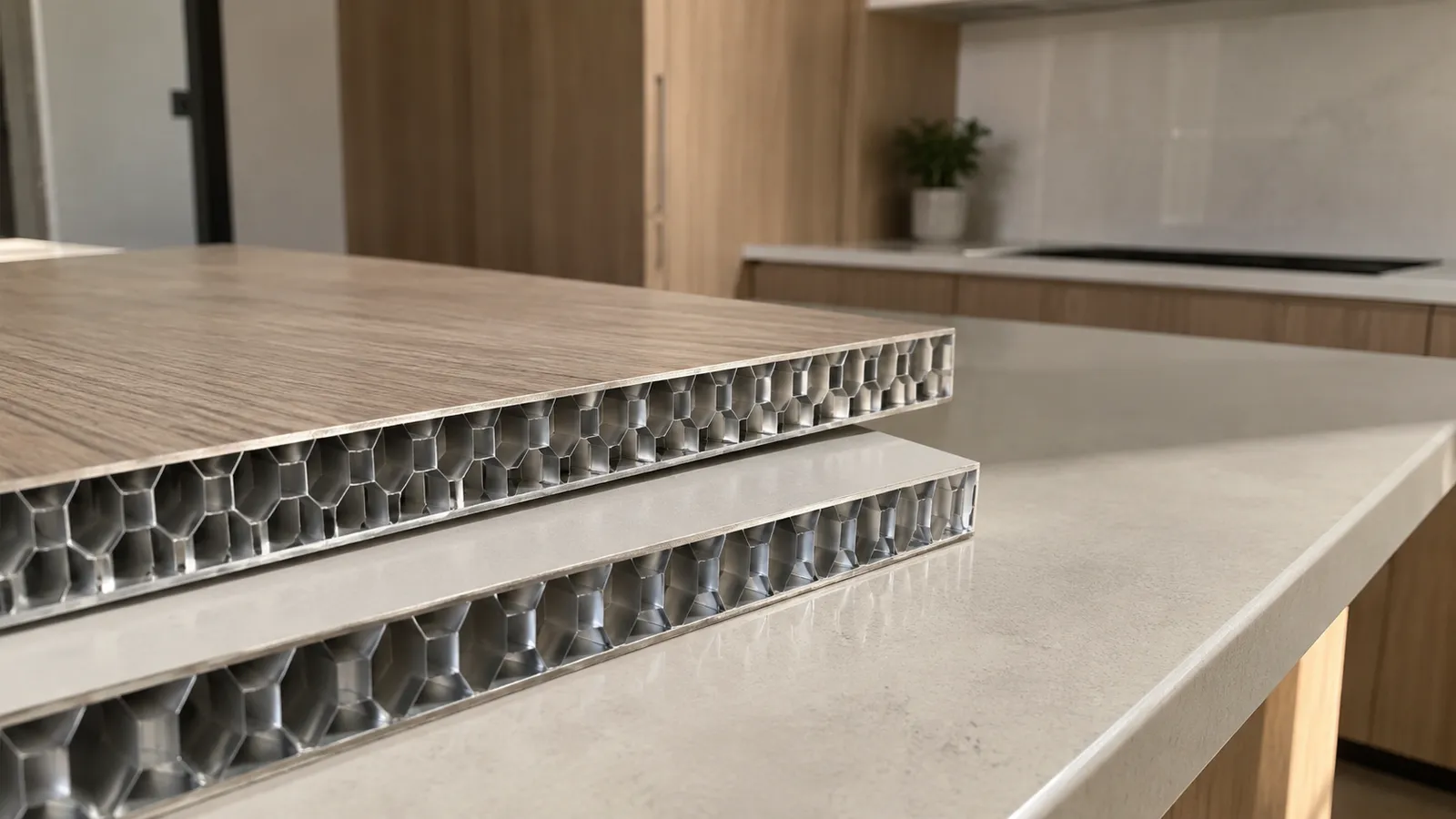
There are many different honeycomb panel configurations on the market, so one brand's construction should not be taken as representative of all products. For aluminium honeycomb panels, the manufacturer currently presents products with a 5-layer structure, combining a colour layer, an SPC stiffening core, and honeycomb walls. The manufacturer develops products into configurations for door systems, partitions, cabinets, and residential or commercial interior items. The manufacturer also provides versions with thicknesses of 9 mm, 18 mm, and 41 mm to meet different application requirements.
The multi-layer approach ensures the material does not rely solely on the core. The honeycomb core plays the role of creating structure and optimising weight, while the layers on both sides contribute to forming the working surface, stability, and aesthetic finish. This is a very important factor in interior production because the end customer does not use the aluminium core alone but uses a complete finished panel that has been machined, edge-banded, fitted with hardware, and placed in a real-world environment.
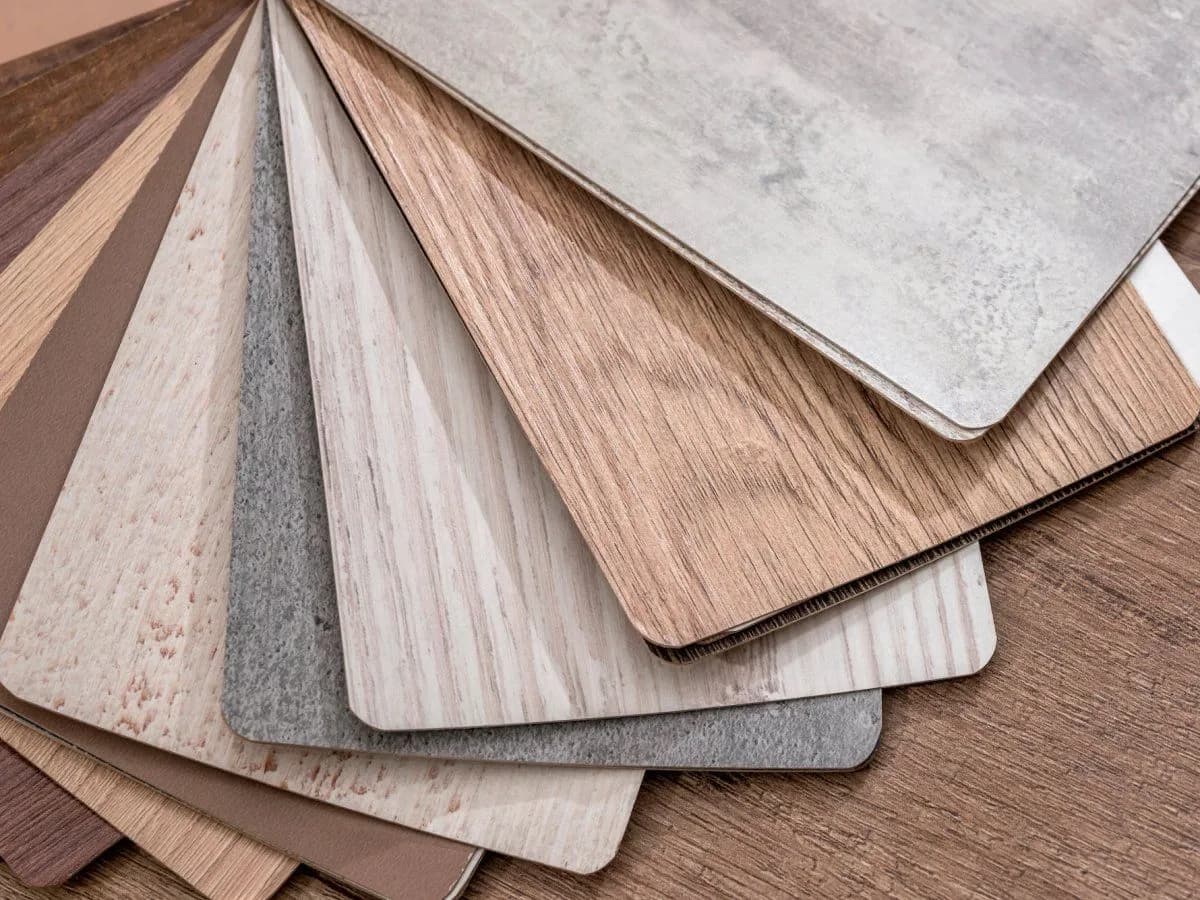
Figure 1.1: Material sample board
In terms of aesthetics, the manufacturer currently develops many surface and colour options so that the metal material is not limited to the original aluminium look. The manufacturer states that honeycomb panel lines can be combined with various colour and finishing solutions, helping them apply to interior styles ranging from modern and minimalist to surfaces simulating wood grain or stone.
When choosing materials, users should therefore view actual samples, check the composition, and ask the supplier for advice on the correct thickness for each item. A cabinet door, a cabinet carcass, and a door set have different technical requirements; using the correct configuration is more important than just choosing by the name “aluminium honeycomb”.
Characteristics of aluminium honeycomb when applied in interiors
Optimised weight, stability, and resistance to warping
One of the reasons the honeycomb structure is widely used in industry is its stiffness-to-weight ratio. Instead of creating a completely solid panel, the honeycomb core uses a network of hollow cells to maintain the distance between two surfaces and create a sandwich structure. As a result, the panel can achieve the rigidity suitable for many applications without having to increase the amount of material in the way a solid panel would. Hexcel also identifies honeycomb as a core type suitable for structures that require high rigidity but want to limit weight increases.
In interiors, this characteristic brings quite practical benefits. A large cabinet door, if too heavy, will create continuous load on the hinges; large doors or partitions also require hardware systems suitable for the weight. When the weight of the material is optimised, the processes of transport, workshop handling, and on-site installation can be more convenient. However, “lightweight” does not mean that technical requirements can be ignored. Screw positions, hardware, panel edges, and bonding methods still need to be calculated according to the product system's construction.
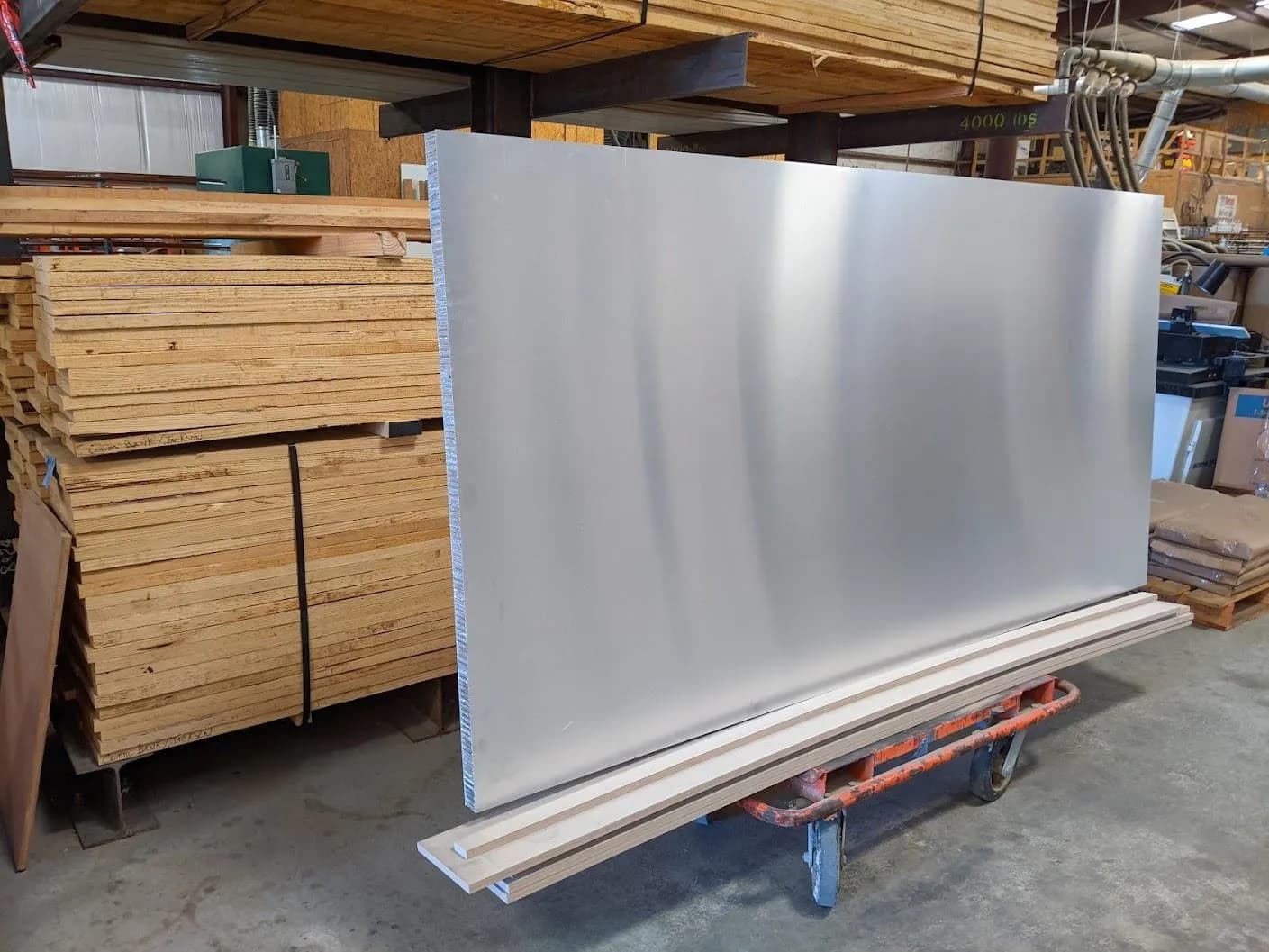
Figure 1.2: Lightweight structure and stability
The ability to resist warping is also a factor that makes aluminium honeycomb interiors attractive. Unlike materials with organic fibre structures that are easily affected by changes in humidity, the metal core does not have the swelling mechanism of wood materials. The manufacturer currently directs the honeycomb panel line towards applications requiring stability such as cabinets and doors. Even so, the long-term flatness of the finished product still depends on the entire panel construction, machining techniques, and actual usage conditions.
Adaptability to water, termites, and usage environments
Kitchen cabinets, vanity units, or cabinets placed near the floor are locations frequently subjected to moisture, water splashes, and cleaning processes. This is also an area where customers often look for water-resistant interior materials to replace those that degrade easily when exposed to humidity for long periods. With a material system using aluminium and non-cellulose components, the risk of becoming a food source for termites is different from wood and wood-based materials. The manufacturer currently markets its honeycomb panels as water-resistant, termite-proof, and warp-resistant.
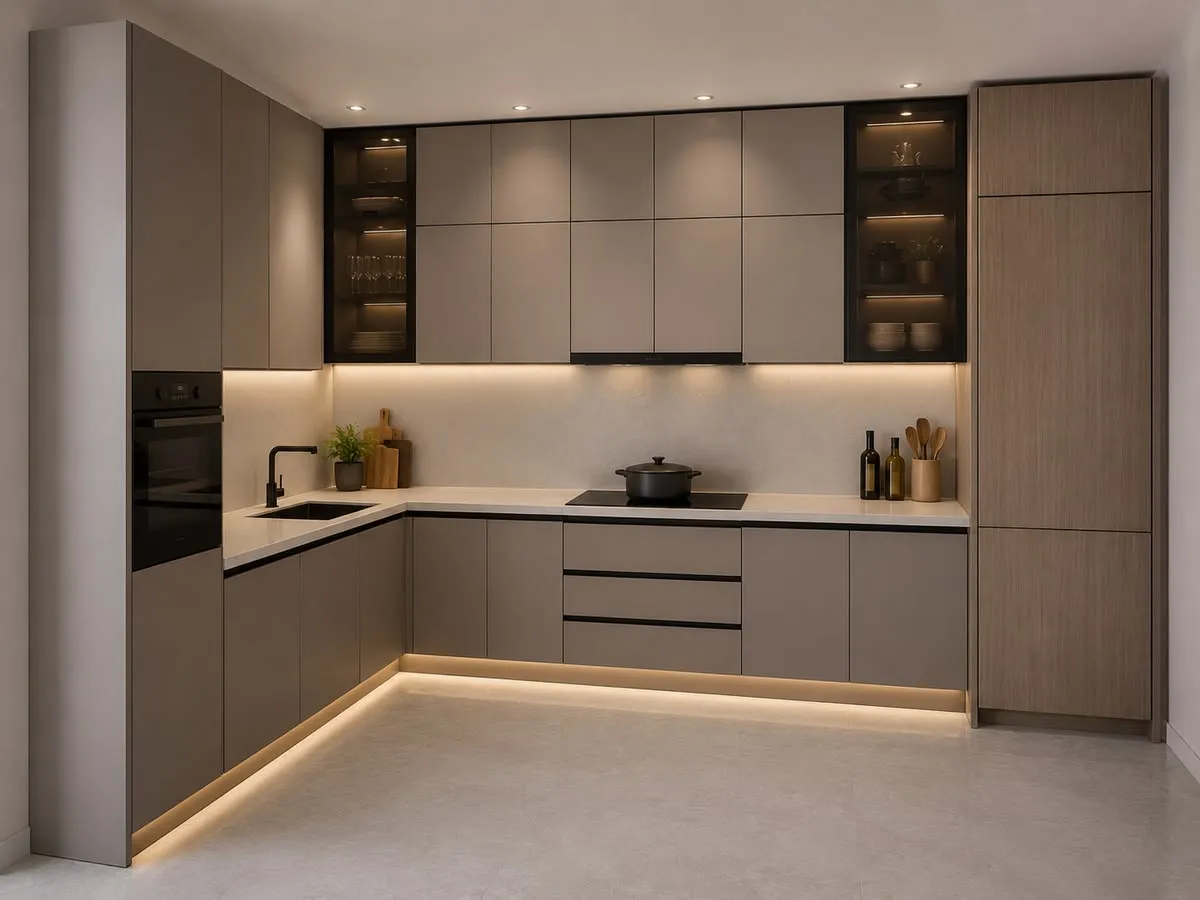
Figure 1.3: Aluminium honeycomb kitchen cabinets
However, from a professional material selection perspective, “water-resistant” should not be understood to mean that every product can be submerged in water or used in any condition without regard for construction. The manufacturer itself notes that water resistance should be evaluated based on the entire product system, including construction, surface layer, panel edges, joint positions, and installation method. A material with good adaptability to humid environments still needs to be processed correctly to limit water ingress into joints or affecting hardware.
Similarly, characteristics such as sound insulation, thermal insulation, or fire resistance should be evaluated according to the specific product configuration and corresponding test reports. Do not assume that all aluminium honeycomb panels have the same performance level just because they use an aluminium core. For projects with special technical requirements, investors and design firms should request product documentation, test results, and the scope of application published by the manufacturer before making a selection.
Applications of aluminium honeycomb in interior design and construction
Kitchen cabinets, vanity units, and cabinets in high-humidity areas
The kitchen is one of the locations that most clearly shows the difference between interior material groups. Steam from cooking, the sink area, floor cleaning water, and air humidity create a more complex usage environment than a bedroom or living room. When a cabinet system has been in use for a long time, the panel edges, the bottom of the sink compartment, and the area near the floor are usually the places that need to be checked first. Therefore, adaptability to humidity is an important criterion when choosing materials for kitchen cabinets.
Aluminium honeycomb kitchen cabinets are favoured for their lightweight structure, stability, and ability to be used in spaces with high humidity requirements. With large cabinet systems, the optimised weight can also support the transport and installation process. The manufacturer also develops honeycomb panels for items such as kitchen cabinets, vanity units, door systems, and other types of furniture.
However, choosing materials for kitchen cabinets should not stop at asking “is it water-resistant?”. Customers need to pay attention to edge treatment, cabinet carcass structure, compatibility with hinges and drawer runners, door construction, hardware drilling positions, and the construction process. The manufacturer also recommends evaluating the construction, thickness, machining method, joints, and usage conditions simultaneously rather than considering a single characteristic in isolation.
For vanity units, this principle is even more important because this is a location with the potential for direct contact with water. A good cabinet system needs to be designed synchronously from materials to joints and hardware, rather than just replacing the door material while keeping the weaknesses of the entire structure.
Wardrobes, shoe cabinets, decorative cabinets, and aluminium honeycomb door systems
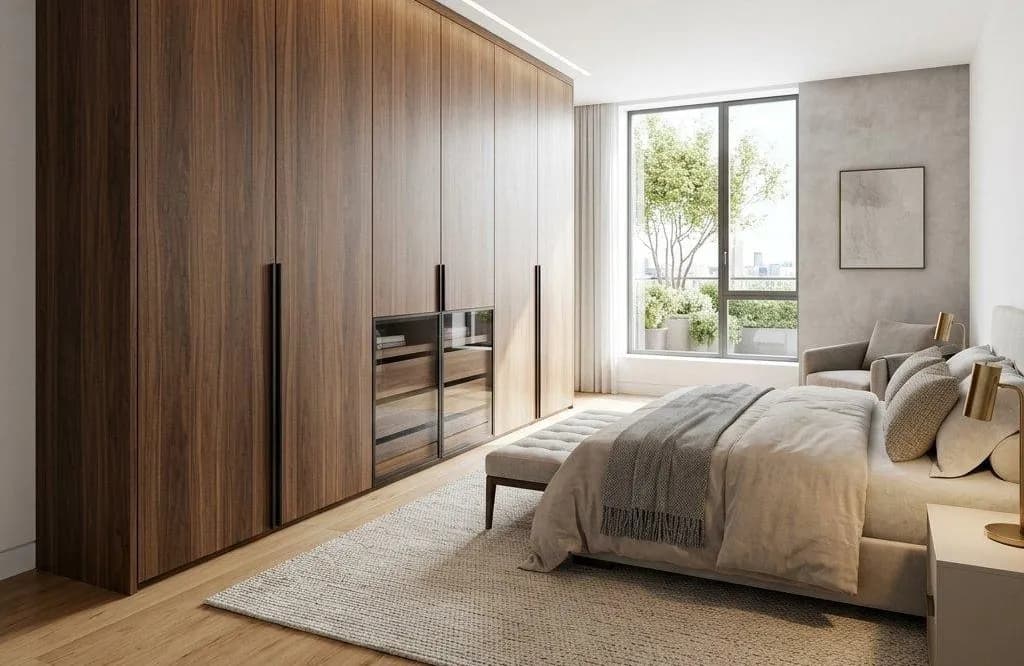
Beyond the kitchen area, aluminium honeycomb also has advantages in large-scale items such as floor-to-ceiling wardrobes, shoe cabinets, decorative cabinets, partitions, and doors. When modern design trends prioritise large flat surfaces and floor-to-ceiling cabinet systems, the weight and stability of the material become factors that need to be considered right from the design stage.
With wardrobes, a tall door system, if using materials that are too heavy, will create greater pressure on the hinges and connection points during opening and closing. Materials with a lightweight structure give designers more options when handling large doors. However, the maximum size of the door must still be determined according to the panel construction, hardware, and technical guidelines of each product system; one should not rely solely on the lightweight advantage to increase size indefinitely.
Similarly, with aluminium honeycomb doors, the lightweight core creates conditions to optimise the weight of the door compared to solid structures, while opening up the possibility of handling large door designs or doors that are synchronous with the interior system. The manufacturer currently identifies doors, partitions, and cabinets as direct application groups for the Honeycomb Panel line.
Aesthetics are also a notable point. Aluminium in interiors does not necessarily have to maintain a cold or monochromatic metal surface. Current finishing layers allow for many colour effects, wood grains, stone grains, or modern surfaces, so the same material system can be deployed throughout from kitchen cabinets and wardrobes to doors and partitions. This is the basis for designing a space that is more synchronous in terms of colour and material language.
Choosing aluminium honeycomb solutions and suitable contractors
Criteria to check before choosing aluminium honeycomb panels
Not all aluminium honeycomb panels on the market have the same construction and quality. Therefore, before comparing prices, customers should determine where the material will be used, the level of water exposure, product size, and the type of hardware expected to be used. A kitchen cabinet placed under a sink has completely different usage conditions to a wardrobe in a bedroom, while a floor-to-ceiling door has different requirements regarding stability and hinge systems.
The next criterion is the construction of the material panel itself. Buyers should research the core, base layer, surface finish, thickness, and edge treatment solutions. If the product is advertised as having fire resistance, sound insulation, low emissions, or meeting a specific standard, one should request documentation or corresponding test results. This is a way to distinguish technical information from promotional descriptions.
For areas with high humidity, do not just ask if the material is “100% water-resistant”. It is necessary to check the edge processing, joints, hardware drilling areas, and on-site treatment plans. The manufacturer itself recommends evaluating the entire product system rather than looking for an absolute conclusion about water resistance.
Finally, there is the capability of the production and construction unit. A good material, if processed with incorrect techniques, incorrect hardware selection, or a design unsuitable for the panel construction, can still reduce usage efficiency. Therefore, practical experience with the specific material chosen is a criterion worth considering when choosing a contractor.
Thiên Tín – Synchronous cabinet and door solutions from aluminium honeycomb panels
From the perspective of an interior supplier, Thiên Tín approaches aluminium honeycomb not simply as a replacement material panel. The real value lies in the ability to integrate the material into a complete product system, in which dimensions, cabinet construction, hardware, surface, and construction methods are selected according to the needs of each space.
For families building new or renovating interiors, using a synchronous material system can help connect the design language between kitchen cabinets, wardrobes, shoe cabinets, vanity units, decorative cabinets, and door systems. Instead of each area using an unrelated solution, materials with many surface options allow architects to better control the colour, lines, and overall feel of the space. At the same time, areas with special requirements regarding water, weight, or size can be handled according to each suitable configuration rather than applying one solution to the entire house.
THIÊN TÍN – A pioneering unit providing synchronous cabinet and door solutions from new-generation aluminium honeycomb panels in Vietnam. With a focus from material consultation, solution selection, and design to production and finishing of cabinet-door systems, Thiên Tín aims to help customers understand the material before deciding, rather than choosing based solely on a few advertised advantages.
If you are considering aluminium honeycomb interiors for your apartment, townhouse, villa, or commercial project, you can contact Thiên Tín to view material samples, compare surfaces, choose configurations suitable for each item, and receive a quotation based on actual needs. A durable interior solution does not start with choosing the most expensive material, but from choosing the right material, the right construction, and the right construction method.
Thiên Tín Journal · Guides · Page 32